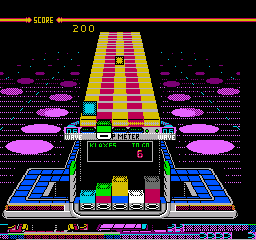
Klax (Japan)
0 2 0
Klax (Japan) is a classic NES puzzle game that mixes action and strategy in a quick-paced, tile-matching challenge. It’s designed for players who like thinking on their feet and planning ahead. The gameplay is simple but addictive, keeping you engaged without overcomplicating things. As an NES-era game, it carries that nostalgic arcade-style charm and still tests your reflexes and planning skills.
Getting Into Klax
The main idea is catching falling tiles from a conveyor belt and stacking them to match colors and shapes. Tiles drop from the top of the screen, and your goal is to line up three or more of the same type in a row—horizontally, vertically, or diagonally. You control a mechanical paddle at the bottom, moving left or right to catch the tiles before they hit the bottom. Once caught, you slide and position the tiles on a grid, aiming to clear lines and keep the pile from reaching the top.
The game gets tougher as new tile types appear and the speed increases. There aren’t different modes—just continuous play until the grid is full. Your challenge is managing the incoming tiles, spotting matches early, and reacting quickly to clear lines. Good placement and planning are key, especially as the pace picks up. It’s a satisfying mix of quick reflexes and puzzle-solving that keeps the game fresh through practice.
Standout Features
Visually, Klax keeps things simple and colorful, making it easy to tell tile types during hectic moments. The progression is steady—faster drop speeds and more complex arrangements encourage you to improve over time. Its straightforward style makes it easy for newcomers to pick up, while the increasing difficulty pushes you to get better with each attempt.
Replay value comes from chasing high scores and trying to improve your reaction times. Each game feels different based on how quickly you adapt to the speed and tile patterns. Since there aren’t complicated mechanics, you can jump right in, but the real challenge is optimizing your tile placement and keeping a steady rhythm. The mix of simplicity and difficulty means it rewards persistence and skill development.
Strategy and Tips
Getting good at Klax takes quick thinking and careful planning. Here are some tips to help you improve:
- Try to create multiple lines at once to boost your score and clear more tiles efficiently.
- Focus on placing tiles that set up future matches rather than just clearing tiles immediately.
- Watch the whole grid, not just the falling tiles, to avoid blocking yourself into tough spots.
- Practice controlling the paddle smoothly so you can catch tiles accurately, especially as the speed ramps up.
- Build stable stacks early to keep things organized and make future placements easier.
- Stay calm when things get fast—panic often causes mistakes that fill up the grid.
Quick Questions
How do I start playing Klax on this site?
The game loads right in your browser—just click to start and use your keyboard or mouse to catch and place tiles.
What’s the biggest mistake beginners make?
Trying to clear tiles too quickly without thinking ahead usually leads to a quick grid fill. Focus on strategic placement first.
Can I play Klax on my phone or tablet?
Since it runs in your browser, it should work on most touch devices, but using a keyboard or mouse makes precise placement easier.
The NES version of Klax offers straightforward puzzle fun that emphasizes speed and planning. Its simple mechanics and rising challenge make it a game worth practicing, especially if you enjoy puzzle-action hybrids. Playing it here keeps the classic feel alive, and getting the rhythm of tile-matching can be quite satisfying.
Related games: you can also try Jackie Chan (Japan) and JJ – Tobidase Daisakusen Part 2 (Japan), or browse all other games in the NES category.
How to Play Klax (Japan)?
Catch falling tiles and arrange them on the grid to match colors and shapes in lines of three or more. Clear tiles efficiently and prevent the pile from reaching the top as speed increases.
Game Controls
Arrow keys move the paddle; other keys handle tile placement and actions.
You may be interested in:
-
![Zombie Hunter (Japan) [En by KingMike v1.01]](https://www.playf2p.com/wp-content/uploads/zombie-hunter-japan-en-by-kingmike-v1-01-200x120.png) NES
♥ 2
Zombie Hunter (Japan) [En by KingMike v1.01]
NES
♥ 2
Zombie Hunter (Japan) [En by KingMike v1.01] -
 NES
♥ 1
Zombie Hunter (Japan)
NES
♥ 1
Zombie Hunter (Japan) -
 NES
♥ 1
Zoids Mokushiroku (Japan)
NES
♥ 1
Zoids Mokushiroku (Japan) -
 NES
♥ 2
Zoids 2 – Zenebas no Gyakushuu (Japan)
NES
♥ 2
Zoids 2 – Zenebas no Gyakushuu (Japan) -
 NES
♥ 1
Zoids – Chuuou Tairiku no Tatakai (Japan)
NES
♥ 1
Zoids – Chuuou Tairiku no Tatakai (Japan) -
 NES
♥ 11
Zippy Race (Japan)
NES
♥ 11
Zippy Race (Japan) -
 NES
♥ 1
Zhen Ben Xi You Ji (Asia) (Unl)
NES
♥ 1
Zhen Ben Xi You Ji (Asia) (Unl) -
 NES
♥ 1
Zenbei!! Pro Basket (Japan)
NES
♥ 1
Zenbei!! Pro Basket (Japan)
Comments (0)
No comments yet. Be the first to comment!