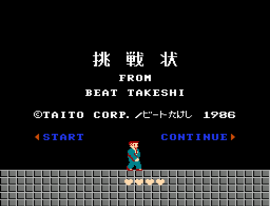
Takeshi no Chousenjou (Japan)
0 5 3
Takeshi no Chousenjou (Japan) is a classic NES game that mixes mini-games, music, and action-adventure gameplay. Its quirky style and challenge-focused design set it apart from more typical titles. Originally released during the NES era, it features short, skill-based segments that test reflexes and timing, all within a humorous, sometimes surreal setting. Now, through browser emulation, players can experience this rare, genre-blending title without needing original hardware or complicated setup.
Takeshi no Chousenjou: Gameplay Overview
The game centers on completing a series of mini-challenges that test timing, coordination, and sometimes musical rhythm. Each one feels like a small puzzle or action scene, often with bizarre or funny themes. You try to get through these challenges to move forward, and failing usually means starting that segment over. The gameplay relies on quick reactions and recognizing patterns, making it fast-paced and at times unpredictable. The rhythm moments combined with traditional action elements mean you need to adapt your approach for each mini-game, which keeps things fresh across multiple tries.
While it’s straightforward overall, its charm comes from its unpredictability and variety of challenges. You’ll encounter segments that need precise timing, quick button presses, or memorizing patterns. Even with its simple setup, the game encourages trying again and again to improve skills and get better results. The music and sound effects often serve as cues for timing or rhythm, adding to the quirky atmosphere. Overall, Takeshi no Chousenjou offers an arcade feel rooted in the NES’s strengths: simple controls, engaging pacing, and immediate feedback.
Modes, Levels and Progression
The game isn’t structured around multiple modes or long levels. Instead, it consists of a series of distinct mini-challenges. Progress depends on completing each one to move ahead. The variety means you’ll face different scenarios, from timing tasks to rhythm segments, each with its own rules and difficulty. As you go through the sequence, challenges tend to get tougher. The short, replayable nature of these segments means you can keep trying individual challenges to improve your scores or skills.
There’s no traditional story or overarching level system, but the sequence of challenges provides a sense of progression through increasing difficulty. This setup makes replaying rewarding, whether you want to beat your best or master specific segments. The focus on quick, skill-based gameplay keeps things interesting across multiple sessions. Designed during the NES era, the difficulty gradually ramps up, offering a challenge for players who enjoy quick bursts of practice.
Winning Strategies
For better results, focus on mastering timing and listening for audio cues. Practice each mini-game separately to build muscle memory. Staying calm during rhythm sections helps keep your timing on track. Recognize patterns in the more predictable challenges to react faster. Use trial and error to learn the nuances of each segment, especially as they get tougher. Patience and consistency pay off, with repeated attempts helping you improve over time.
- Pay close attention to sound cues that tell you when to act.
- Break challenges into smaller parts to understand timing and patterns better.
- Practice difficult sections on their own to develop quick reactions.
- Keep calm to avoid rushing, especially in tight timing moments.
- Try challenges multiple times to notice subtle cues and behaviors.
- Focus on gradual improvement rather than rushing to finish each one perfectly.
Common Questions About Takeshi no Chousenjou
How does the difficulty change as you go along?
Challenges get harder gradually, with each mini-game demanding quicker reactions or more precise timing. Repeated attempts help improve your skills for tougher segments.
Are there different modes or levels?
This game mainly features individual challenges rather than multiple modes or long levels. Its replay value comes from trying to improve at each mini-game rather than unlocking new content.
How long does a typical session last?
Each mini-game usually takes less than a minute, making it easy to fit into short gaming sessions. The total game time depends on how many challenges you want to try and master in one sitting.
This overview gives a clear idea of what to expect from Takeshi no Chousenjou and how to approach its challenges.
Related games: you can also try Pirates! (Europe) and Astro Robo Sasa (Japan), or browse all other games in the NES category.
How to Play Takeshi no Chousenjou (Japan)?
Complete quick mini-challenges that test your timing, coordination, and rhythm to progress through increasingly difficult tasks. Retry segments to improve your skills and achieve higher scores.
Game Controls
Arrow keys act as the D-pad; Enter is Start; action buttons are mapped to keyboard keys.
You may be interested in:
-
![Zombie Hunter (Japan) [En by KingMike v1.01]](https://www.playf2p.com/wp-content/uploads/zombie-hunter-japan-en-by-kingmike-v1-01-200x120.png) NES
♥ 2
Zombie Hunter (Japan) [En by KingMike v1.01]
NES
♥ 2
Zombie Hunter (Japan) [En by KingMike v1.01] -
 NES
♥ 1
Zombie Hunter (Japan)
NES
♥ 1
Zombie Hunter (Japan) -
 NES
♥ 1
Zoids Mokushiroku (Japan)
NES
♥ 1
Zoids Mokushiroku (Japan) -
 NES
♥ 2
Zoids 2 – Zenebas no Gyakushuu (Japan)
NES
♥ 2
Zoids 2 – Zenebas no Gyakushuu (Japan) -
 NES
♥ 1
Zoids – Chuuou Tairiku no Tatakai (Japan)
NES
♥ 1
Zoids – Chuuou Tairiku no Tatakai (Japan) -
 NES
♥ 11
Zippy Race (Japan)
NES
♥ 11
Zippy Race (Japan) -
 NES
♥ 1
Zhen Ben Xi You Ji (Asia) (Unl)
NES
♥ 1
Zhen Ben Xi You Ji (Asia) (Unl) -
 NES
♥ 1
Zenbei!! Pro Basket (Japan)
NES
♥ 1
Zenbei!! Pro Basket (Japan)
Comments (0)
No comments yet. Be the first to comment!