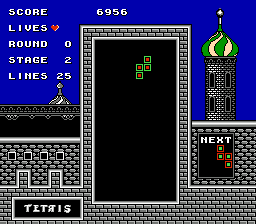
Tetris (Japan)
0 7 2
Tetris (Japan) is a classic NES puzzle game that has become one of the most recognizable titles from early gaming history. The game challenges players to fit falling blocks into complete lines, which then clear from the screen to make space for new pieces. Its simple yet addictive gameplay has made it a staple in gaming, and the NES version stays true to the original experience. Played on the Nintendo Entertainment System, this version emphasizes quick thinking and spatial awareness, making it a favorite for puzzle fans.
Tetris: Gameplay Overview
The main mechanic involves controlling tetrominoes—shapes made of four blocks—that fall from the top of the playfield. Players rotate and move these pieces horizontally to form full horizontal lines without gaps. When a line is completed, it clears, earning points and preventing the stack from reaching the top. As you progress, the speed increases, requiring faster decisions and precise placements.
Strategies often focus on managing the stack so gaps are minimized and setting up multiple line clears at once, like doubles or triples. The game ends when the blocks reach the top of the screen. The controls are simple enough for quick play, but mastering timing and placement gets trickier as the pace quickens. The straightforward rules combined with increasing difficulty have kept Tetris popular for decades.
Modes, Levels and Progression
This NES version mainly features a single mode centered on high scores and survival. The game gets faster as you clear lines, with the falling speed ramping up over time. Unlike newer versions that include different modes or stages, this one keeps the focus on continuous play. The increasing speed naturally pushes players to improve their reaction times and efficiency with each session.
There are no unlockables or branching paths, but the challenge and the goal of beating high scores encourage repeated play. Each game tests your skill, with the pace getting faster, making it suitable for quick sessions or longer efforts to sharpen your skills. Its simplicity allows players to concentrate on spatial reasoning and timing without distractions.
Winning Strategies
To get the most out of your game, aim to build stable stacks that make clearing lines easier. Keeping the top of your stack flat reduces gaps and simplifies placing new pieces. Focus on clearing multiple lines at once for more points.
- Visualize how each piece will fit before dropping it.
- If available, use the hold feature to save useful pieces for later.
- Clear lines efficiently but avoid creating gaps that are hard to fill.
- Stay aware of the increasing fall speed and adjust your pace and decisions accordingly.
- Keep the playfield as low as possible to avoid losing too early.
Common Questions About Tetris
How does the difficulty increase over time?
The game gets faster as you clear more lines, with the pieces falling quicker, which tests your reaction time and planning under pressure.
Are there multiple game modes or levels in this version?
This NES edition mainly offers a single mode focused on high scores and survival, with no separate levels or additional modes. Progression shows up as increased speed rather than new content.
How much replay value does Tetris have here?
The simple mechanics and high-score goal make it very replayable. Each game challenges you to improve your reactions and placements, with no real ending until the stack gets too high.
Playing Tetris here lets fans and newcomers experience one of the most influential puzzle games in a faithful NES format. Its straightforward gameplay conceals a depth of strategy that keeps it engaging, whether you’re casually playing or aiming to improve your best scores.
Related games: you can also try Blaster Master (USA) and Fun Blaster Pak (Australia) (Unl), or browse all other games in the NES category.
How to Play Tetris (Japan)?
Drop and rotate falling blocks to fill horizontal lines completely. Clear lines to score points and prevent the stack from reaching the top, with increasing speed as you progress.
Game Controls
Arrow keys move and rotate pieces; a specific key drops the piece faster; other keys may hold or pause.
You may be interested in:
-
![Zombie Hunter (Japan) [En by KingMike v1.01]](https://www.playf2p.com/wp-content/uploads/zombie-hunter-japan-en-by-kingmike-v1-01-200x120.png) NES
♥ 2
Zombie Hunter (Japan) [En by KingMike v1.01]
NES
♥ 2
Zombie Hunter (Japan) [En by KingMike v1.01] -
 NES
♥ 1
Zombie Hunter (Japan)
NES
♥ 1
Zombie Hunter (Japan) -
 NES
♥ 1
Zoids Mokushiroku (Japan)
NES
♥ 1
Zoids Mokushiroku (Japan) -
 NES
♥ 2
Zoids 2 – Zenebas no Gyakushuu (Japan)
NES
♥ 2
Zoids 2 – Zenebas no Gyakushuu (Japan) -
 NES
♥ 1
Zoids – Chuuou Tairiku no Tatakai (Japan)
NES
♥ 1
Zoids – Chuuou Tairiku no Tatakai (Japan) -
 NES
♥ 11
Zippy Race (Japan)
NES
♥ 11
Zippy Race (Japan) -
 NES
♥ 1
Zhen Ben Xi You Ji (Asia) (Unl)
NES
♥ 1
Zhen Ben Xi You Ji (Asia) (Unl) -
 NES
♥ 1
Zenbei!! Pro Basket (Japan)
NES
♥ 1
Zenbei!! Pro Basket (Japan)
Comments (0)
No comments yet. Be the first to comment!