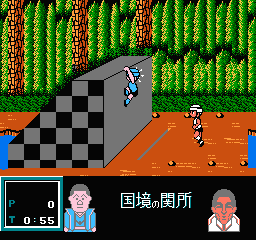
Family Trainer – Totsugeki! Fuuun Takeshi Jou (Japan)
0 16 16
Family Trainer – Totsugeki! Fuuun Takeshi Jou (Japan) is a classic NES game that combines physical activity with light puzzle and platforming elements. Originally released in Japan, this game stands out as an interactive experience that encourages players to move along with the on-screen action, reminiscent of early motion-based gaming. Its design reflects the era’s focus on engaging players through active participation rather than traditional button-mashing. As an NES title, it offers a straightforward yet challenging gameplay loop, making it a nostalgic choice for fans of the system and those interested in active gaming concepts.
Family Trainer – Totsugeki! Fuuun Takeshi Jou: Gameplay Overview
The game operates on a simple premise: players participate physically by mimicking the movements shown on the screen, which may include jumping, ducking, or stepping side to side. It employs a series of mini-games and challenges that require timed responses and coordination, blending the physical with the digital in a way that was innovative for its time. The core gameplay loop involves completing these mini-games successfully to progress through levels, with each stage increasing in difficulty and complexity. The player’s ability to keep up with the physical demands directly impacts their success, creating an interactive experience that extends beyond traditional gaming controls.
This NES classic emphasizes direct engagement, with players often needing to perform specific movements in real-time, making it feel more like an active workout than a conventional platformer or puzzle game. The game’s mechanics are designed to test reflexes and timing, with the emulator running it in your browser providing instant gameplay without any setup or additional hardware. It offers a unique blend of physicality and gaming that sets it apart from typical NES titles, emphasizing fun and activity over intricate storylines or complex mechanics.
Modes, Levels and Progression
The game features a series of levels—each presenting different challenges that build on previous mechanics. Progression is marked by successfully completing one mini-game to unlock the next, with difficulty gradually increasing to test both reaction time and coordination. While it doesn’t feature multiple game modes, the variety of challenges and increasing complexity provide enough depth to keep players engaged through repeated attempts. The game’s design encourages mastery, as players often learn the timing and movements needed to succeed through practice.
Although the total number of levels is limited compared to modern titles, the game’s structure offers enough content to provide a satisfying session of active gameplay. Its focus on physical response means that replayability depends on a player’s desire to improve their performance and beat personal records. The level design emphasizes quick reflexes and adaptability, with each challenge requiring a different set of movements, ensuring that players stay mentally and physically engaged as they progress.
Winning Strategies
Staying attentive to visual cues is crucial; watching the screen carefully helps anticipate upcoming movements. Practice the initial levels to understand the timing required for each mini-game, which improves reaction speed. Maintaining good posture and consistent movements can help prevent fatigue during longer play sessions. Focus on smooth, deliberate actions rather than rushed responses to increase accuracy. Adjust your physical responses to match the game’s demands, paying attention to rhythm and pace. Lastly, repetition is key—replaying levels helps develop muscle memory and increases success rates over time.
Common Questions About Family Trainer – Totsugeki! Fuuun Takeshi Jou
How does the difficulty scale as you progress?
The game increases in difficulty gradually, requiring quicker reactions and more precise movements as levels advance.
Are there different game modes or just one continuous challenge?
It primarily consists of a series of mini-games and challenges that are played consecutively, with no separate modes but increasing complexity within the main game loop.
How long does a typical session last, and is it suitable for repeated play?
A typical playthrough might last around 10-15 minutes, making it suitable for quick sessions or repeated attempts to improve performance and score.
The game offers a straightforward yet engaging experience rooted in physical activity, making family trainer – totsugeki! fuuun takeshi jou a memorable choice for those interested in active NES titles. Its variety of challenges and emphasis on player movement provide a different kind of gameplay that remains accessible and fun decades after its original release.
Related games: you can also try Dig Dug II (Japan) and Baseball (USA, Europe), or browse all other games in the NES category.
How to Play Family Trainer – Totsugeki! Fuuun Takeshi Jou (Japan)?
Follow on-screen prompts to perform physical movements like jumping or ducking in time with the game to complete levels. Progress by successfully finishing mini-games that test your coordination and reflexes.
Game Controls
Arrow keys act as the D-pad; Enter is Start; action keys handle movements.
You may be interested in:
-
![Zombie Hunter (Japan) [En by KingMike v1.01]](https://www.playf2p.com/wp-content/uploads/zombie-hunter-japan-en-by-kingmike-v1-01-200x120.png) NES
♥ 2
Zombie Hunter (Japan) [En by KingMike v1.01]
NES
♥ 2
Zombie Hunter (Japan) [En by KingMike v1.01] -
 NES
♥ 1
Zombie Hunter (Japan)
NES
♥ 1
Zombie Hunter (Japan) -
 NES
♥ 1
Zoids Mokushiroku (Japan)
NES
♥ 1
Zoids Mokushiroku (Japan) -
 NES
♥ 2
Zoids 2 – Zenebas no Gyakushuu (Japan)
NES
♥ 2
Zoids 2 – Zenebas no Gyakushuu (Japan) -
 NES
♥ 1
Zoids – Chuuou Tairiku no Tatakai (Japan)
NES
♥ 1
Zoids – Chuuou Tairiku no Tatakai (Japan) -
 NES
♥ 11
Zippy Race (Japan)
NES
♥ 11
Zippy Race (Japan) -
 NES
♥ 1
Zhen Ben Xi You Ji (Asia) (Unl)
NES
♥ 1
Zhen Ben Xi You Ji (Asia) (Unl) -
 NES
♥ 1
Zenbei!! Pro Basket (Japan)
NES
♥ 1
Zenbei!! Pro Basket (Japan)
Comments (0)
No comments yet. Be the first to comment!