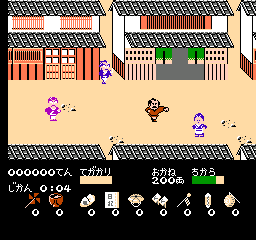
Mito Koumon (Japan)
0 1 0
Mito Koumon (Japan) is a classic NES adventure game that mixes storytelling with exploration and puzzles. As a representative of its genre on the NES, it gives players a chance to enjoy a story rooted in Japanese history and culture, all through pixel art and straightforward gameplay typical of the console’s time. Its focus on character interaction and narrative sets it apart from more action-oriented titles, offering a different kind of challenge that rewards patience and curiosity.
Mito Koumon: Gameplay Overview
This game centers on exploration and making choices, with the player moving through different scenes and talking to characters to move the story forward. The main gameplay involves selecting dialogue options, solving simple puzzles, and making decisions that steer the story. Unlike other NES titles that focus on action, Mito Koumon asks players to pay attention to details and clues during conversations and in the environment.
The interface is simple, with prompts guiding you through different options. Progress depends on understanding the context and choosing the right dialogue or action. The gameplay mostly involves talking to NPCs and examining items or surroundings. This encourages careful exploration and strategic choices, reflecting the style of many story-driven games from that era.
Modes, Levels and Progression
The game moves through a series of story segments, each presenting a new scene or challenge. The content isn’t very deep, with the story unfolding across different scenes that you navigate by making the right choices. There aren’t traditional levels or stages; instead, the game is structured around progressing through narrative chapters, each with its own interactions and puzzles.
You can replay the game to explore different dialogue options and discover alternative story paths. The difficulty is gentle, mainly requiring reading comprehension and decision-making rather than reflexes or combat. This means players can enjoy a story experience that invites multiple playthroughs to uncover all the possible outcomes and details.
Winning Strategies
To do well in Mito Koumon, focus on paying close attention to dialogue clues and environmental details. Here are some tips:
- Take notes on key information from conversations, as it can be helpful for solving puzzles later.
- Choose dialogue options carefully; some responses might lead you down dead ends or miss out on story branches.
- Thoroughly examine each scene for clues or items that can unlock new dialogue options or help progress.
- If you get stuck, go back to earlier scenes and check options you might have missed.
- If possible, save often so you can experiment with different choices without losing progress.
- Pay attention to cultural and historical references, as they can guide your decision-making.
Common Questions About Mito Koumon
Is Mito Koumon a long game?
The length depends on how much you explore and whether you want to see different story endings. Usually, one playthrough takes around one to two hours, but trying different dialogue choices can extend that time.
Does the game have multiple modes or endings?
While mainly linear, the branching dialogue system lets you reach different story outcomes, encouraging replaying to explore other routes and endings.
Is the difficulty suitable for all ages?
Because it focuses on reading, decision-making, and puzzles, it’s best for players comfortable with basic Japanese. Younger players might find the text-heavy parts challenging without help.
Playing Mito Koumon gives a look at a story rooted in Japanese culture, emphasizing exploration and storytelling more than action. This NES classic shows how adventure games of that time approached interactive storytelling, and it still holds up today through browser-based emulation.
Related games: you can also try Castlevania II – Simon's Quest (USA) and Magic Block (Unl), or browse all other games in the NES category.
How to Play Mito Koumon (Japan)?
Explore scenes, talk to characters, and solve puzzles by choosing dialogue options and examining your environment to advance the story. Pay attention to details and make careful decisions to uncover different outcomes.
Game Controls
Arrow keys move; Enter selects; other keys handle dialogue and interactions.
You may be interested in:
-
![Zombie Hunter (Japan) [En by KingMike v1.01]](https://www.playf2p.com/wp-content/uploads/zombie-hunter-japan-en-by-kingmike-v1-01-200x120.png) NES
♥ 2
Zombie Hunter (Japan) [En by KingMike v1.01]
NES
♥ 2
Zombie Hunter (Japan) [En by KingMike v1.01] -
 NES
♥ 1
Zombie Hunter (Japan)
NES
♥ 1
Zombie Hunter (Japan) -
 NES
♥ 1
Zoids Mokushiroku (Japan)
NES
♥ 1
Zoids Mokushiroku (Japan) -
 NES
♥ 2
Zoids 2 – Zenebas no Gyakushuu (Japan)
NES
♥ 2
Zoids 2 – Zenebas no Gyakushuu (Japan) -
 NES
♥ 1
Zoids – Chuuou Tairiku no Tatakai (Japan)
NES
♥ 1
Zoids – Chuuou Tairiku no Tatakai (Japan) -
 NES
♥ 11
Zippy Race (Japan)
NES
♥ 11
Zippy Race (Japan) -
 NES
♥ 1
Zhen Ben Xi You Ji (Asia) (Unl)
NES
♥ 1
Zhen Ben Xi You Ji (Asia) (Unl) -
 NES
♥ 1
Zenbei!! Pro Basket (Japan)
NES
♥ 1
Zenbei!! Pro Basket (Japan)
Comments (0)
No comments yet. Be the first to comment!