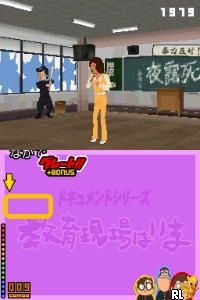
Kayou Generation, The (Japan)
0 1 0
Kayou Generation, The (Japan) is a Nintendo DS game that mixes rhythm, puzzle, and strategy elements. Its gameplay revolves around timing and recognizing patterns, offering a unique experience that makes good use of the handheld console’s dual screens and stylus controls. It stands out among other puzzle titles because of how it uses these features to create an interactive challenge.
Kayou Generation, The: Gameplay Overview
Players interact with rhythmic sequences and visual cues displayed across the two screens. Using the stylus, they need to tap or slide in response to prompts, matching the beat or pattern shown. The main challenge is to perform these actions accurately as the levels get more complex, with faster sequences and more detailed patterns. The mechanics are simple but demand focus, especially as the difficulty increases.
This game emphasizes precision and quick reactions. Players can memorize patterns or react instinctively to visual cues, with successful inputs earning points or unlocking new levels. The dual screens add depth to gameplay—one might show the pattern to follow, while the other provides additional info or a countdown. Each session encourages improving accuracy and rhythm over time, keeping the experience fresh.
Modes, Levels and Progression
The game offers a single gameplay mode that gradually introduces more challenging patterns and faster rhythms. Although it doesn’t have multiple modes or branching paths, the different levels steadily increase in difficulty. New visual and rhythmic elements appear as you progress, prompting you to hone your timing and pattern recognition. Achieving higher scores can unlock extra content or visual themes, adding a little extra motivation.
While the content isn’t overly varied, it provides enough challenge to keep players coming back. The levels are designed to test reflexes and memory, making it suitable for quick play sessions or longer practice when aiming for high scores. Its focus on pattern accuracy and timing makes it engaging, especially for those who enjoy precise, skill-based gameplay that makes good use of the Nintendo DS’s touchscreen and dual screens.
Winning Strategies
Getting the hang of rhythm and pattern recognition helps a lot. Here are some tips:
- Pay attention to visual cues and try to anticipate upcoming sequences to react faster.
- Use the stylus confidently; hesitation can cause mistakes.
- Practice early levels to memorize patterns, which makes faster stages easier.
- Stay calm during rapid sequences to keep your accuracy high instead of rushing.
- Find a comfortable grip so you can reach both screens easily and respond quickly.
- Focus on consistent timing rather than perfection on every input for better scores.
Common Questions About Kayou Generation, The
Does the difficulty increase significantly as I go?
Yes, the sequences speed up and get more complex, requiring quicker reactions and better memorization. The challenge grows gradually so it doesn’t become overwhelming too soon.
Are there multiple modes or levels I can pick from?
Mostly, you’re playing a single mode that gets harder as you progress. It doesn’t have different modes or branching paths, but the variety within the core gameplay keeps it interesting for repeated tries.
How long does a typical session last?
Most sessions last around 10 to 20 minutes, depending on your skill and how much you want to improve your scores. The design makes it easy to play short bursts or work toward higher scores over time.
This Nintendo DS title offers a simple yet challenging experience that focuses on rhythm and accuracy. Playing Kayou Generation, The here gives quick access to its core mechanics, making it a good pick for fans of puzzle and rhythm games.
Related games: you can also try Dokodemo Raku Raku! – DS Kakeibo (Japan) and Heroes of Mana (USA), or browse all other games in the Nintendo DS category.
How to Play Kayou Generation, The (Japan)?
Follow rhythmic prompts on the screens by tapping or sliding with the keyboard to match patterns and improve your score as the sequences get faster and more complex.
Game Controls
Arrow keys or WASD for navigation; action keys for tapping or sliding.
You may be interested in:
-
 Nintendo DS
♥ 1
Casper’s Scare School – Classroom Capers (USA)
Nintendo DS
♥ 1
Casper’s Scare School – Classroom Capers (USA) -
 Nintendo DS
♥ 1
Zunou Nouryoku Koujou Machine – Touch de Zunoo DS (Japan)
Nintendo DS
♥ 1
Zunou Nouryoku Koujou Machine – Touch de Zunoo DS (Japan) -
 Nintendo DS
♥ 1
Zunou ni Asekaku Game Series! Vol. 1 – Cool 104 Joker & Setline (Japan)
Nintendo DS
♥ 1
Zunou ni Asekaku Game Series! Vol. 1 – Cool 104 Joker & Setline (Japan) -
 Nintendo DS
♥ 9
Zuma’s Revenge (USA)
Nintendo DS
♥ 9
Zuma’s Revenge (USA) -
 Nintendo DS
♥ 1
Zubo (USA) (En,Fr,Es)
Nintendo DS
♥ 1
Zubo (USA) (En,Fr,Es) -
 Nintendo DS
♥ 1
Zubo (Europe) (En,Fr,De,Es,It,Nl,Sv)
Nintendo DS
♥ 1
Zubo (Europe) (En,Fr,De,Es,It,Nl,Sv) -
 Nintendo DS
♥ 1
Zorro – Quest for Justice (USA) (En,Fr,De,Es,It)
Nintendo DS
♥ 1
Zorro – Quest for Justice (USA) (En,Fr,De,Es,It) -
 Nintendo DS
♥ 1
Zorro – Quest for Justice (Europe) (En,Fr,De,Es,It)
Nintendo DS
♥ 1
Zorro – Quest for Justice (Europe) (En,Fr,De,Es,It)
Comments (0)
No comments yet. Be the first to comment!