Professor Layton and Pandora’s Box (Europe)
0 1 0
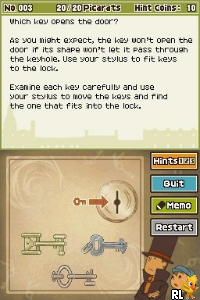
Professor Layton and Pandora’s Box (Europe) is a puzzle adventure game originally made for the Nintendo DS, a handheld console known for its dual-screen setup and stylus input. This classic from the Nintendo DS era combines a compelling story with brain-teasing puzzles, focusing on logical reasoning and deduction rather than action. As part of the Professor Layton series, it offers a mix of story-driven exploration and challenging problem-solving, all brought to life with charming visuals and a distinctive art style that fits the platform well.
Professor Layton and Pandora’s Box: Gameplay Overview
In this game, you take on the role of Professor Layton, a well-known puzzle solver, trying to uncover the secrets of a mysterious box that appears in Misthallery. The main gameplay involves solving a variety of puzzles, each requiring different skills like mathematical reasoning, pattern recognition, lateral thinking, and logic deduction. Puzzles are often embedded within dialogue or appear as standalone challenges, encouraging you to think critically and try different solutions.
The puzzles are woven into the story, which unfolds through dialogue and animated scenes. You interact using the touchscreen, tapping and dragging to explore objects and choose options. The dual screens help you view clues and puzzle details side by side. The game keeps track of your progress through a puzzle database, so you can revisit puzzles if needed. The balance between story and puzzles creates a relaxed but mentally engaging experience, with difficulty gradually increasing as you move through the story, challenging both casual players and puzzle enthusiasts alike.
Modes, Levels and Progression
This game is structured around chapters, each with several puzzles and story segments. It doesn’t have multiple game modes but instead focuses on progressing through the story, with new puzzles unlocking as you advance. Puzzle difficulty ranges from simple riddles to more complex logic challenges, providing a good mix to keep things interesting. How long it takes depends on how quickly you solve puzzles, but most players can expect several hours of gameplay. Some puzzles are meant to be revisited to improve solutions or find hidden secrets.
As you solve puzzles and piece together the story, you unlock extra content and clues that deepen the narrative. There aren’t traditional levels like in arcade games; instead, progress is tied to completing story segments. If you want to replay puzzles, you can try to solve them more efficiently or explore different approaches, especially since some can be pretty tricky and might require multiple attempts.
Winning Strategies
Patience and careful observation help keep things moving smoothly. Here are some tips:
- Pay close attention to all visual and textual clues in the puzzle environment.
- Use the stylus to experiment with different interactions; trying multiple approaches can sometimes lead to solutions.
- If you get stuck, go back to earlier puzzles or hints—you might have missed something important.
- Keep track of puzzles that gave you trouble so you can revisit them later; some puzzles have hidden solutions or alternate methods.
- Don’t rush through the story; absorbing the narrative can give clues for tougher puzzles down the line.
- Try to balance your focus between story and puzzles so you don’t miss important contextual hints.
Common Questions About Professor Layton and Pandora’s Box
How does the difficulty change as you play?
The puzzles start off relatively simple and get more complex, requiring more deductive reasoning and lateral thinking as you move through the chapters.
Are there different game modes or just one story?
The game follows a single story, with puzzles unlocking in sequence rather than separate modes or difficulty settings.
How much replay value is there?
While the main story is linear, you can revisit puzzles to improve your solutions or find hidden secrets, which adds some replayability even after finishing the game.
Playing Professor Layton and Pandora’s Box offers a solid puzzle experience that mixes story and logic without feeling overwhelming. Its thoughtful progression and variety of challenges make it enjoyable to revisit, keeping it a memorable part of the Nintendo DS lineup even now in a browser-based format.
Related games: you can also try My Animal Centre in Africa (Europe) (En,Fr,De,Es,It) and I Did It Mum! – Spelling (Europe) (En,Fr,De,Es,It), or browse all other games in the Nintendo DS category.
How to Play Professor Layton and Pandora’s Box (Europe)?
Solve puzzles by interacting with the screen using your keyboard to uncover the story of Professor Layton and Pandora's Box, progressing through chapters by completing challenges and exploring clues.
Game Controls
Arrow keys act as the D-pad; Enter is used for selecting and confirming actions.
You may be interested in:
-
 Nintendo DS
♥ 1
Casper’s Scare School – Classroom Capers (USA)
Nintendo DS
♥ 1
Casper’s Scare School – Classroom Capers (USA) -
 Nintendo DS
♥ 1
Zunou Nouryoku Koujou Machine – Touch de Zunoo DS (Japan)
Nintendo DS
♥ 1
Zunou Nouryoku Koujou Machine – Touch de Zunoo DS (Japan) -
 Nintendo DS
♥ 1
Zunou ni Asekaku Game Series! Vol. 1 – Cool 104 Joker & Setline (Japan)
Nintendo DS
♥ 1
Zunou ni Asekaku Game Series! Vol. 1 – Cool 104 Joker & Setline (Japan) -
 Nintendo DS
♥ 9
Zuma’s Revenge (USA)
Nintendo DS
♥ 9
Zuma’s Revenge (USA) -
 Nintendo DS
♥ 1
Zubo (USA) (En,Fr,Es)
Nintendo DS
♥ 1
Zubo (USA) (En,Fr,Es) -
 Nintendo DS
♥ 1
Zubo (Europe) (En,Fr,De,Es,It,Nl,Sv)
Nintendo DS
♥ 1
Zubo (Europe) (En,Fr,De,Es,It,Nl,Sv) -
 Nintendo DS
♥ 1
Zorro – Quest for Justice (USA) (En,Fr,De,Es,It)
Nintendo DS
♥ 1
Zorro – Quest for Justice (USA) (En,Fr,De,Es,It) -
 Nintendo DS
♥ 1
Zorro – Quest for Justice (Europe) (En,Fr,De,Es,It)
Nintendo DS
♥ 1
Zorro – Quest for Justice (Europe) (En,Fr,De,Es,It)
Comments (0)
No comments yet. Be the first to comment!