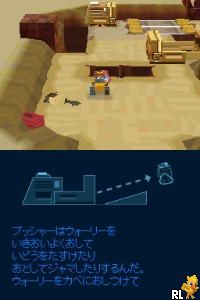
WALL-E (Japan)
0 1 0
WALL-E (Japan) is a Nintendo DS game that captures the charm and storytelling style of the Pixar film through side-scrolling action. It focuses on exploration and platforming, blending puzzle-solving with adventure elements on the dual-screen handheld. As a title from the Nintendo DS era, it uses the console’s features to create a straightforward gameplay experience suitable for players of all ages.
WALL-E: Gameplay Overview
The game mainly involves guiding WALL-E through different environments to complete tasks that often include collecting items, avoiding dangers, and solving simple puzzles. The DS’s touchscreen and dual screens are used to make interactions more intuitive; players might tap, swipe, or use the stylus to move objects or explore the world. The main activity is exploring levels, gathering specific items, and moving through stages that get a bit more complex as you go.
This game emphasizes precise platforming along with environmental puzzles. Timing your jumps and movements is key, especially since obstacles and enemies demand quick reflexes and planning. The mechanics are easy to pick up but still offer enough challenge to keep things interesting, with familiar platforming elements adapted for the portable format.
Modes, Levels and Progression
The game follows a linear path through a series of levels that tell the story of WALL-E’s adventure. Each stage introduces new challenges, environments, and puzzles, encouraging players to explore for hidden items or shortcuts. While it doesn’t have multiple modes, replay value comes from finding collectibles and trying to improve your scores or finish levels faster.
Different environments like scrapyards and space stations keep things visually interesting, with each having its own obstacles. As you progress, the difficulty gradually increases, requiring better timing and problem-solving skills. You need to complete levels to unlock the next ones, making it suitable for short sessions or longer play if aiming for 100% completion or high scores.
Winning Strategies
Work on timing your jumps and interactions to avoid hazards efficiently. Use the touchscreen carefully for puzzles and object manipulation instead of rushing. Look out for clues in the environment that might lead to hidden paths or useful items. Trying different approaches to tricky sections can help find the best route. Keep track of your collected items and objectives so you don’t miss anything that unlocks new stages. Practicing platforming segments, especially in later levels, will improve your control and reaction time.
- Explore thoroughly to find hidden items or shortcuts.
- Use the stylus gently to interact with objects and avoid mistakes.
- Pay attention to enemy patterns and environmental clues for timing your moves.
- Replay levels to improve your scores or discover new routes.
- Manage your resources carefully to prevent getting stuck.
- Take breaks if a section gets frustrating and return later with a fresh outlook.
Common Questions About WALL-E
Does the difficulty increase as I go along?
Yes, puzzles and hazards become more challenging, requiring better timing and planning.
Are there replayable modes or extra content?
No separate modes, but you can replay levels to beat your scores, find hidden items, or finish faster.
How long does it take to finish WALL-E?
The main story can be completed in a few hours, but collecting everything and perfecting your runs might take longer.
This Nintendo DS game offers a simple yet engaging platforming experience, with a focus on exploration and puzzles. Its mechanics and charming style make it a fun choice, especially for fans of the film or those looking for a nostalgic puzzle-platformer you can enjoy anywhere.
Related games: you can also try Shaun the Sheep – Off His Head (Europe) (En,Fr,De,Es,It) and Russel Grant's Astrology (Europe) (En,Fr,De,Es,It), or browse all other games in the Nintendo DS category.
How to Play WALL-E (Japan)?
Guide WALL-E through levels by jumping, exploring, and solving puzzles to collect items and reach the end. Use timing and environment clues to overcome obstacles and progress through the story.
Game Controls
Arrow keys control movement; action keys use the keyboard or mouse for jumping, interacting, and solving puzzles.
You may be interested in:
-
 Nintendo DS
♥ 1
Casper’s Scare School – Classroom Capers (USA)
Nintendo DS
♥ 1
Casper’s Scare School – Classroom Capers (USA) -
 Nintendo DS
♥ 1
Zunou Nouryoku Koujou Machine – Touch de Zunoo DS (Japan)
Nintendo DS
♥ 1
Zunou Nouryoku Koujou Machine – Touch de Zunoo DS (Japan) -
 Nintendo DS
♥ 1
Zunou ni Asekaku Game Series! Vol. 1 – Cool 104 Joker & Setline (Japan)
Nintendo DS
♥ 1
Zunou ni Asekaku Game Series! Vol. 1 – Cool 104 Joker & Setline (Japan) -
 Nintendo DS
♥ 9
Zuma’s Revenge (USA)
Nintendo DS
♥ 9
Zuma’s Revenge (USA) -
 Nintendo DS
♥ 1
Zubo (USA) (En,Fr,Es)
Nintendo DS
♥ 1
Zubo (USA) (En,Fr,Es) -
 Nintendo DS
♥ 1
Zubo (Europe) (En,Fr,De,Es,It,Nl,Sv)
Nintendo DS
♥ 1
Zubo (Europe) (En,Fr,De,Es,It,Nl,Sv) -
 Nintendo DS
♥ 1
Zorro – Quest for Justice (USA) (En,Fr,De,Es,It)
Nintendo DS
♥ 1
Zorro – Quest for Justice (USA) (En,Fr,De,Es,It) -
 Nintendo DS
♥ 1
Zorro – Quest for Justice (Europe) (En,Fr,De,Es,It)
Nintendo DS
♥ 1
Zorro – Quest for Justice (Europe) (En,Fr,De,Es,It)
Comments (0)
No comments yet. Be the first to comment!