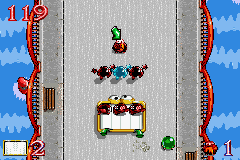
Hot Potato (E)(Patience)
0 1 0
Hot Potato (E)(Patience) is a classic Game Boy Advance action game that mixes fast reactions with strategic timing. As part of the handheld’s library, it offers a straightforward experience that focuses on timing and recognizing patterns. Its simple mechanics make it easy for players of all ages to pick up, yet the challenge keeps more experienced gamers on their toes. Since it’s a Game Boy Advance title, it benefits from the portable nature and nostalgic feel of that era, and now you can play it directly in your browser without any downloads or installations.
Hot Potato: Gameplay Overview
The main idea in Hot Potato is reacting to a quick-changing game environment. You’re managing a virtual “hot potato” that needs to be passed or avoided at just the right moments. The game shows on-screen prompts, and you press the right button or perform specific actions in sync with the rhythm. If you miss the timing, you might lose the round or face penalties. It’s all about quick reflexes and precise timing, which makes each game tense and satisfying.
The difficulty ramps up as you go, with faster tempos and more intricate patterns. As you progress, you’ll face a variety of challenges that test your ability to spot patterns and react quickly. The game emphasizes fast decision-making—hesitate or get the timing wrong, and you fail. The mechanics are simple but demand focus, encouraging you to stay sharp if you want to beat your high scores or finish levels with as few mistakes as possible.
Modes, Levels and Progression
Hot Potato’s progression system is pretty straightforward. It’s mainly about increasing difficulty rather than offering different game modes. The main variation comes from the speed and complexity of the challenges. Each level you complete unlocks the next, with no elaborate story or diverse levels. Still, the rising difficulty provides a steady challenge, testing your reflexes and pattern recognition over time.
The stages are somewhat minimal in variety but introduce different timing patterns or small tweaks to the core mechanic. The game is designed for quick play sessions, making it good for short bursts or casual gaming. Replayability comes from trying to beat your best scores and mastering each pattern’s timing—especially satisfying if you enjoy sharpening your reactions and reflexes.
Winning Strategies
Getting better at Hot Potato is about honing your timing and staying calm under pressure. Here are some tips:
- Recognize the rhythm early so you can prepare your responses ahead of time.
- Keep relaxed; tension makes hesitation more likely.
- Practice the initial patterns to develop muscle memory for quicker reactions.
- Watch for subtle visual signals that hint at upcoming pattern changes.
- If you notice consistent mistakes at certain points, adjust your response timing slightly.
- Try to keep your eyes on the entire pattern rather than just specific cues, so you don’t miss transitions.
Common Questions About Hot Potato
How does difficulty change as you go?
The game gradually speeds up prompts and introduces more complex patterns, requiring faster reactions and better pattern recognition. The difficulty curve feels natural, challenging your reflexes without sudden jumps, so it’s suitable whether you’re casual or more serious about your scores.
Are there different modes or levels with unique mechanics?
Hot Potato mainly focuses on passing or avoiding the “hot potato” through timing challenges. There aren’t separate modes, but the increasing complexity and speed levels add enough variety to keep things interesting. No story or unlockable modes—just progressing through levels offers a sense of achievement.
How much replay value does it have?
Playing again to beat your high scores or improve reaction times keeps it fresh. Its quick sessions make it ideal for casual play, and mastering the timing can be quite satisfying. The simple setup encourages repeated tries, with the main goal being to get faster and more accurate each time.
This classic from the Game Boy Advance days remains accessible yet challenging. Its focus on timing and reflexes means that even short gaming sessions can be intense and rewarding, perfect for players looking for quick, skill-based fun.
Related games: you can also try Asterix and Obelix XXL (E)(Rising Sun) and Densetsu no Stafi 3 (J)(Caravan), or browse all other games in the Game Boy Advance category.
How to Play Hot Potato (E)(Patience)?
React quickly to on-screen prompts to pass or avoid the hot potato. Time your button presses accurately as the game speeds up and patterns change to keep the game challenging.
Game Controls
Arrow keys or keyboard buttons act as the game controls; press in sync with prompts.
You may be interested in:
-
 Game Boy Advance
♥ 2
Zooo (J)(Rising Sun)
Game Boy Advance
♥ 2
Zooo (J)(Rising Sun) -
 Game Boy Advance
♥ 4
Zooo (E)(Trashman)
Game Boy Advance
♥ 4
Zooo (E)(Trashman) -
 Game Boy Advance
♥ 2
ZooCube (U)(Mode7)
Game Boy Advance
♥ 2
ZooCube (U)(Mode7) -
 Game Boy Advance
♥ 1
ZooCube (E)(Blizzard)
Game Boy Advance
♥ 1
ZooCube (E)(Blizzard) -
 Game Boy Advance
♥ 1
Zone of the Enders – The Fist of Mars (U)(Mode7)
Game Boy Advance
♥ 1
Zone of the Enders – The Fist of Mars (U)(Mode7) -
 Game Boy Advance
♥ 1
Zone of the Enders – The Fist of Mars (E)(Cezar)
Game Boy Advance
♥ 1
Zone of the Enders – The Fist of Mars (E)(Cezar) -
 Game Boy Advance
♥ 1
Zoku Bokura no Taiyou – Taiyou Shounen Django (J)(Independent)
Game Boy Advance
♥ 1
Zoku Bokura no Taiyou – Taiyou Shounen Django (J)(Independent) -
 Game Boy Advance
♥ 7
Zoku Bokura no Taiyou – Taiyou Shounen Django (J)(Caravan)
Game Boy Advance
♥ 7
Zoku Bokura no Taiyou – Taiyou Shounen Django (J)(Caravan)
Comments (0)
No comments yet. Be the first to comment!