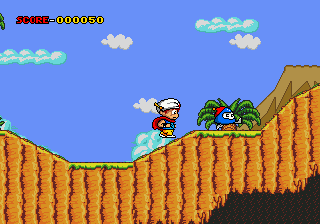
Magical Hat no Buttobi Turbo! Daibouken (Japan)
0 10 1
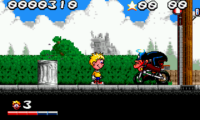
Magical Hat no Buttobi Turbo! Daibouken is a classic Genesis game that captures the spirit of platformers with its quirky design and unique mechanics. Coming from the Sega Genesis era, it offers players a simple yet fun action experience, with bright visuals and easy controls. Its style and gameplay make it a notable choice for fans of vintage platformers wanting to revisit or discover a memorable title from that time.
Magical Hat no Buttobi Turbo! Daibouken: Gameplay Overview
The game is about guiding a lively, magical hat through various levels filled with obstacles, enemies, and jumping challenges. The main mechanic involves precise jumps and timing, with the hat often bouncing off surfaces or enemies to move forward. Players need to get the rhythm right to dodge hazards and pick up items, which boost scores or give temporary power-ups.
The controls are simple and responsive, allowing for smooth movement. The real challenge comes from managing momentum and timing, especially as the levels get tougher. While the game keeps things straightforward, it rewards players who develop good spatial awareness and quick reflexes, making each successful run satisfying.
Levels, Modes, and Progression
This Genesis title features a series of levels that gradually add more complexity, introducing new obstacles and enemies along the way. The progression is mostly linear, with players clearing stages to move ahead. The different level designs help keep the experience fresh, each offering new layouts and challenges, which encourages players to adapt their strategies.
The game doesn’t include multiple modes like multiplayer or difficulty settings, but the variety in level design offers enough reason to replay. Those aiming for high scores or perfect runs will likely come back often. Its relatively short length makes it good for quick gaming sessions, though mastering the mechanics can take some time, especially for full completion or high scores.
Winning Strategies
Focus on timing your jumps well to avoid falling or getting hit. Patience and careful observation are key—watch how enemies move before rushing in.
- Use bounce mechanics wisely by timing your jumps to save momentum during tricky sections.
- Collect items whenever possible to boost your score and gain helpful power-ups.
- Learn each level’s layout through repeated play to find safe paths and shortcuts.
- Pay attention to enemy spawn points and patterns to avoid unnecessary damage.
- Practice levels multiple times to sharpen your reflexes and develop muscle memory for tough parts.
Common Questions About Magical Hat no Buttobi Turbo! Daibouken
Does the difficulty ramp up as I go?
Yes, later levels tend to feature faster enemies and more complex platform setups, calling for quicker reactions and better timing.
Are there different game modes or just one path through the game?
The game mainly follows a linear path through levels. While it doesn’t have alternate modes, the variety in level design keeps things interesting.
How much replay value is there for high scores or perfect runs?
There’s plenty of reason to replay, especially if you’re trying to improve your scores or master each level’s layout and enemy patterns. Its short length makes quick sessions possible, but getting good can take practice.
Playing Magical Hat no Buttobi Turbo! Daibouken here gives quick access to a well-kept example of Genesis platforming. Its simple gameplay with increasing difficulty offers a fun challenge for fans of retro action games.
Related games: you can also try Global Gladiators (Europe) and Light Crusader (Korea) (En,Kr), or browse all other games in the Genesis category.
How to Play Magical Hat no Buttobi Turbo! Daibouken (Japan)?
Guide the magical hat through levels by timing jumps and bouncing off surfaces to avoid obstacles, defeat enemies, and collect items for points and power-ups.
Game Controls
Arrow keys control movement; jump and action keys are mapped to specific keyboard buttons.
You may be interested in:
-
 Genesis
♥ 2
Master of Weapon (Japan)
Genesis
♥ 2
Master of Weapon (Japan) -
 Genesis
♥ 15
Master of Monsters (USA)
Genesis
♥ 15
Master of Monsters (USA) -
 Genesis
♥ 1
Master of Monsters (Japan)
Genesis
♥ 1
Master of Monsters (Japan) -
 Genesis
♥ 4
Marvel Land (USA)
Genesis
♥ 4
Marvel Land (USA) -
 Genesis
♥ 2
Marvel Land (Japan)
Genesis
♥ 2
Marvel Land (Japan) -
 Genesis
♥ 20
Marsupilami (USA) (En,Fr,De,Es,It)
Genesis
♥ 20
Marsupilami (USA) (En,Fr,De,Es,It) -
 Genesis
♥ 2
Marsupilami (Europe) (En,Fr,De,Es,It)
Genesis
♥ 2
Marsupilami (Europe) (En,Fr,De,Es,It) -
 Genesis
♥ 12
Marko’s Magic Football (USA)
Genesis
♥ 12
Marko’s Magic Football (USA)
Comments (0)
No comments yet. Be the first to comment!