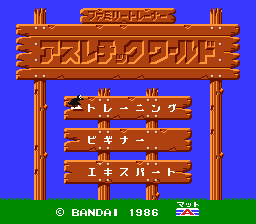
Family Trainer 1 – Athletic World (Japan)
0 5 5
Family Trainer 1 – Athletic World (Japan) is a classic NES game that combines physical activity with a straightforward platforming challenge. Originally released in the era of cartridge-based gaming, this title invites players to simulate athletic tasks through a series of mini-games and obstacle courses. Its focus on motion and timing makes it stand out among NES titles, offering a different kind of gameplay that tests your coordination rather than reflexes alone. Playing it in your browser provides a nostalgic glimpse into the era when gaming was about more than just button mashing; it was about engaging your body as well as your mind.
Why Family Trainer 1 – Athletic World Is Worth Playing
This game’s charm lies in its unique premise: it’s designed to mimic athletic training through a series of mini-games that challenge your timing and coordination. The visuals keep true to the NES’s pixel art style, with bright colors and simple animations that evoke the early 80s and 90s gaming scene. The atmosphere feels energetic, with each obstacle course feeling like a physical challenge you might encounter in a real gym. The game encourages repeat attempts because mastering each course requires precise timing and patience, making it appealing for casual players who want a bit of light exercise and dedicated players looking for a nostalgic workout.
The game’s mechanics are straightforward but demand focus. Because it simulates physical activity, success often hinges on understanding the rhythm and pacing of each mini-game. Despite its simplicity, it offers enough variety in its obstacle courses to keep players returning. The in-browser emulation runs smoothly, so you can focus on the challenge rather than technical hiccups. Overall, this classic from the NES era offers a fun, active experience that’s easy to pick up but hard to master, especially if you enjoy games that blend motion with puzzle-like timing.
Tips to Get Ahead
Getting into the groove of Family Trainer 1 – Athletic World is easier with a few helpful pointers.
- Focus on timing rather than brute force; most challenges reward patience over speed.
- Observe the pattern of obstacles before attempting to pass; memorization helps.
- Use small, controlled movements to navigate tricky sections, especially when precise timing is key.
- Practice difficult sections separately to improve your overall score and endurance.
- Don’t rush through courses; a slower, more deliberate approach often yields better results.
- Stay relaxed, as tension can throw off your coordination on the more demanding parts of the game.
Things to Know Before You Start
How long does a typical session last?
A session usually involves completing one or two obstacle courses, which can take anywhere from a few minutes to around ten, depending on your skill level. Expect some trial and error, especially early on.
Is Family Trainer 1 – Athletic World suitable for casual players?
Absolutely. Its simple mechanics and straightforward objectives make it accessible for players of all ages, though mastering the timing can still pose a challenge for newcomers.
How difficult is the game for experienced players?
While the basics are simple, the game can become quite tricky as you aim for higher scores or try to beat your personal best. It rewards patience and precise control, making it engaging for dedicated players seeking a challenge.
Jump into Family Trainer 1 – Athletic World and see how your coordination measures up. It’s a straightforward, engaging NES classic that offers a different flavor of gameplay, perfect for those who remember the era’s emphasis on fun and challenge in equal measure.
Related games: you can also try Code Name – Viper (USA) and Dragon Ball 3 – Gokuu Den (Japan), or browse all other games in the NES category.
How to Play Family Trainer 1 – Athletic World (Japan)?
Complete obstacle courses by timing your movements and actions carefully to simulate athletic tasks. Focus on patience and observation to master each mini-game and improve your score.
Game Controls
Arrow keys control movement; action keys handle jumping, grabbing, or other actions.
You may be interested in:
-
![Zombie Hunter (Japan) [En by KingMike v1.01]](https://www.playf2p.com/wp-content/uploads/zombie-hunter-japan-en-by-kingmike-v1-01-200x120.png) NES
♥ 2
Zombie Hunter (Japan) [En by KingMike v1.01]
NES
♥ 2
Zombie Hunter (Japan) [En by KingMike v1.01] -
 NES
♥ 1
Zombie Hunter (Japan)
NES
♥ 1
Zombie Hunter (Japan) -
 NES
♥ 1
Zoids Mokushiroku (Japan)
NES
♥ 1
Zoids Mokushiroku (Japan) -
 NES
♥ 2
Zoids 2 – Zenebas no Gyakushuu (Japan)
NES
♥ 2
Zoids 2 – Zenebas no Gyakushuu (Japan) -
 NES
♥ 1
Zoids – Chuuou Tairiku no Tatakai (Japan)
NES
♥ 1
Zoids – Chuuou Tairiku no Tatakai (Japan) -
 NES
♥ 11
Zippy Race (Japan)
NES
♥ 11
Zippy Race (Japan) -
 NES
♥ 1
Zhen Ben Xi You Ji (Asia) (Unl)
NES
♥ 1
Zhen Ben Xi You Ji (Asia) (Unl) -
 NES
♥ 1
Zenbei!! Pro Basket (Japan)
NES
♥ 1
Zenbei!! Pro Basket (Japan)
Comments (0)
No comments yet. Be the first to comment!