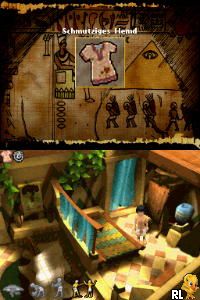
Ankh – Der Fluch des Skarabaeenkoenigs (Germany) (En,Fr,De)
0 1 0
Ankh – Der Fluch des Skarabaeenkoenigs (Germany) (En,Fr,De) is a classic Nintendo DS adventure game that combines puzzle-solving with exploration based on ancient Egyptian themes. It stands out for its engaging story and point-and-click mechanics, offering a nostalgic feel reminiscent of earlier adventure titles. Made for the Nintendo DS, it uses the handheld’s dual screens to create a visually interesting interface that balances puzzles with storytelling. As a game from the DS era, it appeals to players who enjoy detailed environments, logical challenges, and a touch of mythology, all playable directly in your browser without extra downloads. Its release in Germany includes multiple languages, making it accessible to a wide audience familiar with European releases.
Ankh – Der Fluch des Skarabaeenkoenigs: Gameplay Overview
The gameplay relies on point-and-click adventure mechanics, where players move through scenes by tapping objects and characters on the touchscreen. The main activity involves exploring environments, collecting items, and solving puzzles that move the story forward. It encourages careful observation and logical thinking, asking players to piece clues together and interact with their surroundings. The dual-screen setup shows the environment on one side and inventory or dialogue options on the other, making navigation straightforward. Puzzles are fair but challenging, often involving combining items or deciphering hieroglyphs, which requires players to think critically about what they see and find.
The story unfolds as players solve puzzles that reveal more about the characters and plot. The interface is simple, with touch controls making item selection and dialogue choices easy. The design suits those who enjoy exploring step-by-step with a bit of story mixed in, making each session a mix of solving mysteries and uncovering secrets from ancient times. The pacing balances puzzle difficulty with narrative, typical of Nintendo DS adventure titles.
Modes, Levels and Progression
While the main story is linear, the game features multiple scenes and locations that players explore one after another. Each scene acts as a puzzle hub, with different challenges that require varied approaches, adding layers to the gameplay. Progress follows the story, unlocking new areas and story elements as you solve puzzles and find clues. It doesn’t have multiple difficulty levels but gradually becomes more complex, encouraging careful thought about what to do next. Puzzles range from decoding hieroglyphs to manipulating objects, keeping things interesting throughout the game.
The story develops through scenes that come together as players piece together the mystery of the cursed mummy and the tomb. Replayability comes from revisiting scenes to find missed clues or trying different solutions. The game mainly offers a single playthrough, but some puzzles can be approached in different ways, allowing for some experimentation. Paying close attention to details across each scene can really pay off, rewarding players who explore thoroughly.
Winning Strategies
Taking your time and inspecting each scene carefully can save frustration. Keep track of clues and items you collect, as many puzzles depend on using things in the right way. Don’t rush conversations—important hints are often hidden in dialogue. If you’re stuck, go back to earlier scenes to double-check for missed clues or objects you might have overlooked. Patience and logical thinking are key, especially as puzzles get trickier. Sometimes solutions require thinking outside the box, so try different uses for items or interpret clues from different angles.
- Pay attention to hieroglyphs and symbols—they often serve as codes or clues for puzzles.
- Use your inventory wisely; combine items and consider their potential uses in new contexts.
- Explore every corner of each scene to find hidden objects or subtle hints that aren’t immediately obvious.
- Read dialogue carefully, as NPCs may give important clues about solving puzzles or understanding the story.
- Take notes if needed, especially for puzzles with multiple steps or symbols to decode.
- If progress slows, revisit earlier scenes to make sure you’ve checked everything.
Common Questions About Ankh – Der Fluch des Skarabaeenkoenigs
How does the difficulty change as you play?
The puzzles get more complex as you move forward, with early ones acting as tutorials and later challenges needing more thinking and combining items. Some solutions may require lateral thinking, adding to the challenge.
Are there multiple endings or options to replay?
The story mostly follows a straight path, but revisiting puzzles and trying different approaches can add some replay value. Still, the main story stays the same across playthroughs.
Can I play this offline or on mobile devices?
Since it runs in your browser, you can play it on any device with internet access and a compatible browser. It’s designed to work without installing anything, making it easy to access on desktops, tablets, and smartphones.
All in all, Ankh – Der Fluch des Skarabaeenkoenigs offers a classic adventure experience for fans of puzzles and Egyptian mythology. Its pacing and variety of challenges make it a game you can pick up and enjoy multiple times. Playing in your browser makes it convenient to explore the mysteries of ancient Egypt without extra setup, so you can focus on solving the ancient secrets at your leisure.
Related games: you can also try Adibou – Je Joue a Lire et a Compter (France) and 12 Family Games (Europe), or browse all other games in the Nintendo DS category.
How to Play Ankh – Der Fluch des Skarabaeenkoenigs (Germany) (En,Fr,De)?
Explore ancient Egyptian scenes by clicking objects and solving puzzles to uncover the story and progress through different locations. Collect items, decipher clues, and interact to advance the adventure.
Game Controls
Arrow keys move the cursor; Enter selects and interacts with objects and dialogue.
You may be interested in:
-
 Nintendo DS
♥ 1
Casper’s Scare School – Classroom Capers (USA)
Nintendo DS
♥ 1
Casper’s Scare School – Classroom Capers (USA) -
 Nintendo DS
♥ 1
Zunou Nouryoku Koujou Machine – Touch de Zunoo DS (Japan)
Nintendo DS
♥ 1
Zunou Nouryoku Koujou Machine – Touch de Zunoo DS (Japan) -
 Nintendo DS
♥ 1
Zunou ni Asekaku Game Series! Vol. 1 – Cool 104 Joker & Setline (Japan)
Nintendo DS
♥ 1
Zunou ni Asekaku Game Series! Vol. 1 – Cool 104 Joker & Setline (Japan) -
 Nintendo DS
♥ 9
Zuma’s Revenge (USA)
Nintendo DS
♥ 9
Zuma’s Revenge (USA) -
 Nintendo DS
♥ 1
Zubo (USA) (En,Fr,Es)
Nintendo DS
♥ 1
Zubo (USA) (En,Fr,Es) -
 Nintendo DS
♥ 1
Zubo (Europe) (En,Fr,De,Es,It,Nl,Sv)
Nintendo DS
♥ 1
Zubo (Europe) (En,Fr,De,Es,It,Nl,Sv) -
 Nintendo DS
♥ 1
Zorro – Quest for Justice (USA) (En,Fr,De,Es,It)
Nintendo DS
♥ 1
Zorro – Quest for Justice (USA) (En,Fr,De,Es,It) -
 Nintendo DS
♥ 1
Zorro – Quest for Justice (Europe) (En,Fr,De,Es,It)
Nintendo DS
♥ 1
Zorro – Quest for Justice (Europe) (En,Fr,De,Es,It)
Comments (0)
No comments yet. Be the first to comment!