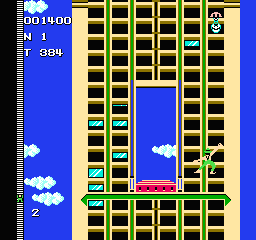
Crazy Climber (Japan)
0 4 2
Crazy Climber (Japan) is a classic NES action and platformer that tasks players with scaling the sides of buildings while dodging falling debris, windows, and other hazards. Its straightforward gameplay makes it accessible for newcomers, yet mastering the timing and rhythm adds layers of challenge for seasoned players. This NES title offers a simple but addictive experience, and now you can enjoy it right in your browser without any downloads or setups.
What Is Crazy Climber?
Crazy Climber is a side-scrolling arcade-style game where you control a climber trying to reach the top of tall skyscrapers. The goal is to go as high as possible while avoiding falling bricks, windows, and various obstacles that could knock you down. Success depends on precise timing and quick reflexes, with the climber moving left or right and jumping between ledges as the building’s facade becomes more dangerous.
This game falls into the action and platformer categories, focusing on vertical movement and obstacle avoidance. The gameplay is quite simple: climb higher without falling or getting hit. As levels progress, the challenge increases with faster falling objects and more complex building layouts. Its visual style is minimal but effective, emphasizing clarity so players can react quickly and plan their moves.
What Keeps You Coming Back
The excitement of beating your high scores and the challenge of staying alive longer motivate players to keep climbing. Each run feels different because the timing of falling objects varies, adding unpredictability. Its straightforward design encourages repeated attempts to sharpen skills and reach higher levels.
The game’s simplicity and quick sessions also add to its replay value. You can pick it up for a few minutes, try to beat your previous score, or just enjoy navigating tricky obstacles. Its arcade roots bring a nostalgic feeling, especially for those who enjoy mastering timing and reactions. The increasing difficulty keeps it engaging, even for experienced players who want to test their limits over multiple tries.
Handy Tips
If you’re starting out or trying to improve, these tips might help you stay on the building longer:
- Time your jumps carefully to avoid falling debris and windows.
- Watch the pattern of falling objects—sometimes they follow a rhythm you can take advantage of.
- Make short, controlled movements instead of rushing to reduce mistakes.
- Focus on staying on the building rather than rushing upward for quick points.
- Keep an eye out for upcoming hazards and think a few seconds ahead.
- If you’re stuck, pause briefly and wait for a safe moment before continuing.
Player FAQ
Is Crazy Climber easy for new players to pick up?
Yes, the controls are simple, and the goal is clear, making it accessible for players of all ages and skill levels.
Can younger players enjoy Crazy Climber?
While the mechanics are straightforward, the increasing difficulty might be challenging for some younger players. Still, its simple gameplay suits most age groups.
Do I need an internet connection to play Crazy Climber?
No, once loaded on this site, it runs directly in your browser without needing an internet connection. That makes it easy to play anytime, anywhere.
This NES classic remains a fun challenge that tests reflexes and timing. Its simple idea and rising difficulty mean you’ll probably want to keep trying, especially as you aim for higher scores. Playing Crazy Climber offers a glimpse into arcade history in a way that’s easy to access and still enjoyable today.
Related games: you can also try 3-D Block (Asia) (Unl) (Hwang Shinwei) and Aussie Rules Footy (Australia), or browse all other games in the NES category.
How to Play Crazy Climber (Japan)?
Climb the building by moving left or right and jumping to avoid falling debris and obstacles, aiming to reach the highest point possible without falling or getting hit.
Game Controls
Arrow keys control movement; other keys handle jumping and actions as mapped.
You may be interested in:
-
![Zombie Hunter (Japan) [En by KingMike v1.01]](https://www.playf2p.com/wp-content/uploads/zombie-hunter-japan-en-by-kingmike-v1-01-200x120.png) NES
♥ 2
Zombie Hunter (Japan) [En by KingMike v1.01]
NES
♥ 2
Zombie Hunter (Japan) [En by KingMike v1.01] -
 NES
♥ 1
Zombie Hunter (Japan)
NES
♥ 1
Zombie Hunter (Japan) -
 NES
♥ 1
Zoids Mokushiroku (Japan)
NES
♥ 1
Zoids Mokushiroku (Japan) -
 NES
♥ 2
Zoids 2 – Zenebas no Gyakushuu (Japan)
NES
♥ 2
Zoids 2 – Zenebas no Gyakushuu (Japan) -
 NES
♥ 1
Zoids – Chuuou Tairiku no Tatakai (Japan)
NES
♥ 1
Zoids – Chuuou Tairiku no Tatakai (Japan) -
 NES
♥ 11
Zippy Race (Japan)
NES
♥ 11
Zippy Race (Japan) -
 NES
♥ 1
Zhen Ben Xi You Ji (Asia) (Unl)
NES
♥ 1
Zhen Ben Xi You Ji (Asia) (Unl) -
 NES
♥ 1
Zenbei!! Pro Basket (Japan)
NES
♥ 1
Zenbei!! Pro Basket (Japan)
Comments (0)
No comments yet. Be the first to comment!