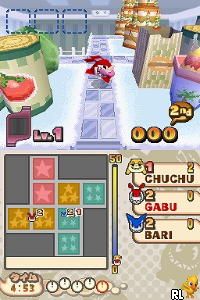
Gabu Gabu Planet (Japan)
0 1 0
Gabu Gabu Planet (Japan) is a charming Nintendo DS game that combines puzzle-solving with a fun, arcade-style gameplay loop. Its simple mechanics and approachable difficulty make it suitable for players of different ages and skill levels. The straightforward design and focus on quick, repetitive challenges give it a nostalgic feel, reminiscent of many handheld titles from the Nintendo DS era.
Gabu Gabu Planet: Gameplay Overview
The main mechanic involves controlling a character who needs to consume objects appearing on the screen in a specific order. The game’s core interaction is selecting and “eating” objects in sequence, aiming to match patterns or clear the screen efficiently. Controls are minimal, so it’s easy to pick up and enjoy in short sessions—a common trait in many Nintendo DS puzzle games.
As players move forward, new patterns and faster waves of objects appear. The gameplay rewards quick reflexes and pattern recognition, especially for players who develop a sharp eye for sequences. While the mechanics stay simple, increasing speed and complexity challenge reaction times and planning skills. It’s a game that lends itself well to short bursts but can also be played longer, especially if you’re aiming for high scores or specific challenges.
Modes, Levels and Progression
Gabu Gabu Planet features a straightforward progression system. Each stage gets a bit tougher with new object patterns and faster tempos, demanding sharper focus and quicker decisions. The main appeal lies in scoring and personal improvement rather than complex storylines or unlockable content.
Despite its simplicity, the game keeps things interesting with different wave types and pattern combinations. It doesn’t have multiple modes, but the challenge comes from mastering its core mechanics. Levels are short, encouraging players to replay sections to sharpen their skills or push for higher scores. The replay value mainly comes from personal competition rather than varied content.
Winning Strategies
To do well in Gabu Gabu Planet, try to recognize patterns quickly and keep a steady rhythm. Focus on accuracy before speed at first to build a solid base.
- Watch the sequence of objects carefully and plan your moves ahead of time.
- Stay calm during fast waves to avoid mistakes.
- Practice specific patterns to improve reaction times over multiple plays.
- Use visual cues and color coding to tell objects apart and reduce hesitation.
- Set small goals for each session, like clearing a number of waves without errors.
- Stick to deliberate actions rather than rushing, especially in later levels.
Common Questions About Gabu Gabu Planet
Does the difficulty increase gradually or suddenly?
The difficulty ramps up gradually, with new patterns and faster speeds introduced as you progress, testing reaction times and pattern recognition.
Are there different modes or just one gameplay style?
This game features a single core mode focused on clearing object waves. The challenge comes from increasing difficulty and scoring, not different modes.
How much replay value does it have?
Replaying to beat high scores and master patterns keeps it interesting. It’s suitable for quick sessions or longer tries to improve personal bests.
Gabu Gabu Planet offers a simple but engaging experience that emphasizes quick reflexes and pattern recognition. Its straightforward approach makes it easy to pick up but still provides enough challenge to stay fun over multiple sessions. As a classic Nintendo DS game emulated directly in your browser, it offers a nostalgic taste of handheld puzzle gaming without any extra setup needed.
Related games: you can also try Fall fuer TKKG, Ein – Detektiv Gesucht! (Germany) and Around the World in 80 Days (Europe) (En,Fr,Nl), or browse all other games in the Nintendo DS category.
How to Play Gabu Gabu Planet (Japan)?
Match and eat objects in the correct order as they appear, focusing on quick recognition and steady rhythm to clear waves and improve your score.
Game Controls
Arrow keys move; spacebar or Enter selects and eats objects.
You may be interested in:
-
 Nintendo DS
♥ 1
Casper’s Scare School – Classroom Capers (USA)
Nintendo DS
♥ 1
Casper’s Scare School – Classroom Capers (USA) -
 Nintendo DS
♥ 1
Zunou Nouryoku Koujou Machine – Touch de Zunoo DS (Japan)
Nintendo DS
♥ 1
Zunou Nouryoku Koujou Machine – Touch de Zunoo DS (Japan) -
 Nintendo DS
♥ 1
Zunou ni Asekaku Game Series! Vol. 1 – Cool 104 Joker & Setline (Japan)
Nintendo DS
♥ 1
Zunou ni Asekaku Game Series! Vol. 1 – Cool 104 Joker & Setline (Japan) -
 Nintendo DS
♥ 9
Zuma’s Revenge (USA)
Nintendo DS
♥ 9
Zuma’s Revenge (USA) -
 Nintendo DS
♥ 1
Zubo (USA) (En,Fr,Es)
Nintendo DS
♥ 1
Zubo (USA) (En,Fr,Es) -
 Nintendo DS
♥ 1
Zubo (Europe) (En,Fr,De,Es,It,Nl,Sv)
Nintendo DS
♥ 1
Zubo (Europe) (En,Fr,De,Es,It,Nl,Sv) -
 Nintendo DS
♥ 1
Zorro – Quest for Justice (USA) (En,Fr,De,Es,It)
Nintendo DS
♥ 1
Zorro – Quest for Justice (USA) (En,Fr,De,Es,It) -
 Nintendo DS
♥ 1
Zorro – Quest for Justice (Europe) (En,Fr,De,Es,It)
Nintendo DS
♥ 1
Zorro – Quest for Justice (Europe) (En,Fr,De,Es,It)
Comments (0)
No comments yet. Be the first to comment!