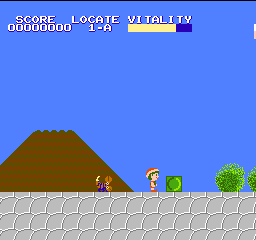
Mystery Quest (USA)
0 2 1
Mystery Quest (USA) is a classic NES platformer that combines straightforward action with exploration elements, characteristic of many titles from the system’s era. Its simple yet engaging gameplay makes it accessible to players seeking a nostalgic experience, while its puzzle-like progression offers enough challenge to keep veteran gamers interested. The game’s design emphasizes skillful navigation through levels filled with obstacles and enemies, demanding both timing and strategy from the player.
Mystery Quest: Gameplay Overview
The core of Mystery Quest involves moving through side-scrolling stages full of platforms, hazards, and enemies. As a platformer, it relies on jump-based movement, precise timing, and recognizing patterns to avoid dangers and reach the end of each level. The mechanics are typical of the genre, with the player controlling a character who can jump, climb, and sometimes interact with objects or switches within the environment.
Progression is fairly linear, with players advancing from one stage to the next, each offering different layouts and challenges. While it doesn’t include complex combat or power-ups, it rewards good movement and an awareness of the environment. Completing levels usually means navigating enemy encounters and solving environmental puzzles, testing reflexes and problem-solving skills from start to finish.
Modes, Levels and Progression
Mystery Quest offers a single-player experience that takes you through a series of levels designed to test platforming skills. The levels differ in layout, with some requiring precise jumps and timing, while others focus on puzzle-like elements that need careful observation. The progression is straightforward: clear one level to unlock the next, with difficulty gradually increasing but staying within the challenge level typical of early NES titles.
The game doesn’t feature multiple modes or branching paths, but replaying earlier stages to improve scores or times can be satisfying. The difficulty ramps up steadily, with later levels introducing more complex platform arrangements and quicker enemy movements. Overall, the variety in level design offers enough content to keep players engaged over multiple sessions, even if it’s a relatively short adventure for its time.
Winning Strategies
Getting through Mystery Quest hinges on understanding enemy behaviors and mastering precise jumps. Patience and careful observation help, especially in tricky sections. Here are some practical tips:
- Watch enemy movements before rushing into a new area to avoid unnecessary hits.
- Practice timing your jumps to land safely on moving or shaky platforms.
- Use the environment, like waiting for enemies to pass before moving forward.
- Revisit earlier levels to refine your approach and improve your times.
- Keep control of your character instead of rushing through levels.
- If possible, memorize level layouts to save time on subsequent attempts.
Common Questions About Mystery Quest
How does the difficulty change as I go through the levels?
The challenge ramps up gradually, with later stages featuring more complex platform setups and faster enemy patterns, typical of early NES games. The first levels act as tutorials, while the later ones demand better timing and awareness.
Are there different modes or variations in the game?
No, it’s a straightforward experience focused on completing levels. Replaying levels to beat previous scores or times adds some variety but there are no alternate modes or branching paths.
How much replay value does it have?
Going back to improve your times or scores can keep you coming back. Since the game is relatively short, players who enjoy mastering each stage might find it satisfying to perfect their runs and face the challenge of doing better each time.
Playing Mystery Quest through this browser emulation gives a good look at early NES platforming. Its simple gameplay and level design make it a solid choice for fans of classic titles who enjoy timing and environmental challenges. As a mystery quest, it encourages careful exploration and practice, offering a taste of NES’s early platforming style.
Related games: you can also try Honey Peach – Mei Nv Quan (Asia) (Unl) and Bomber Remilia, or browse all other games in the NES category.
How to Play Mystery Quest (USA)?
Move through levels by jumping and avoiding enemies, solving puzzles and reaching the end of each stage. Progress sequentially to complete the game, using timing and observation to overcome obstacles.
Game Controls
Arrow keys control movement; action buttons are mapped to keyboard keys for jumping and interacting.
You may be interested in:
-
![Zombie Hunter (Japan) [En by KingMike v1.01]](https://www.playf2p.com/wp-content/uploads/zombie-hunter-japan-en-by-kingmike-v1-01-200x120.png) NES
♥ 2
Zombie Hunter (Japan) [En by KingMike v1.01]
NES
♥ 2
Zombie Hunter (Japan) [En by KingMike v1.01] -
 NES
♥ 1
Zombie Hunter (Japan)
NES
♥ 1
Zombie Hunter (Japan) -
 NES
♥ 1
Zoids Mokushiroku (Japan)
NES
♥ 1
Zoids Mokushiroku (Japan) -
 NES
♥ 2
Zoids 2 – Zenebas no Gyakushuu (Japan)
NES
♥ 2
Zoids 2 – Zenebas no Gyakushuu (Japan) -
 NES
♥ 1
Zoids – Chuuou Tairiku no Tatakai (Japan)
NES
♥ 1
Zoids – Chuuou Tairiku no Tatakai (Japan) -
 NES
♥ 11
Zippy Race (Japan)
NES
♥ 11
Zippy Race (Japan) -
 NES
♥ 1
Zhen Ben Xi You Ji (Asia) (Unl)
NES
♥ 1
Zhen Ben Xi You Ji (Asia) (Unl) -
 NES
♥ 1
Zenbei!! Pro Basket (Japan)
NES
♥ 1
Zenbei!! Pro Basket (Japan)
Comments (0)
No comments yet. Be the first to comment!