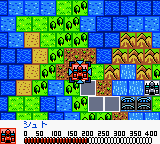
Game Boy Wars 3 (Japan)
0 1 0
Game Boy Wars 3 (Japan) is a strategy game originally released for the Game Boy Color, focusing on tactical combat and managing units. As part of a long-running series, it’s known for its turn-based gameplay and detailed grid-based battlefield, providing a challenging experience for fans of classic strategy titles. The game keeps much of the series’ depth and complexity, making it a notable addition to the Game Boy Color library. Now, you can play it directly in your browser without needing to download anything.
Game Boy Wars 3: Gameplay Overview
The main idea behind Game Boy Wars 3 is turn-based tactical combat. You command an army on a top-down grid map, moving units, attacking enemies, and capturing key positions to gain advantages. Different unit types have their own strengths and weaknesses, so planning your moves carefully and adapting to changing battlefield conditions is key. Victory depends on managing resources well, positioning units smartly, and understanding what each unit can do.
The gameplay cycle involves selecting units, moving them, and resolving battles through a straightforward but strategic system. You’ll need to consider risks when attacking versus holding your position, as each move can change the course of the game. It emphasizes planning over quick reflexes, which was typical for strategy games on consoles from that era.
Modes, Levels and Progression
Game Boy Wars 3 features different game modes, including single-player campaigns and head-to-head battles. Its content is based on scenarios that challenge you to beat increasingly tough enemy setups and objectives. Progression usually involves completing missions that unlock new units and tactics, broadening your tactical options.
The game includes various maps and enemy arrangements, encouraging replayability. As you advance through missions, the difficulty ramps up, pushing you to refine your strategies and use your units wisely. While it doesn’t focus on a continuous story, its variety of scenarios and difficulty levels keep the gameplay interesting for fans of turn-based strategy.
Winning Strategies
Good positioning is crucial; controlling high ground and choke points can really influence the outcome.
- Protect weaker units by surrounding them with stronger ones to keep your formation intact and last longer in fights.
- Use reconnaissance units early on to spot enemy positions and plan your approach.
- Balance attack and defense, avoiding overextending and leaving units exposed.
- Capture strategic points early to gather resources and limit enemy options.
- Save special abilities or powerful units for critical moments instead of using them too soon.
Common Questions About Game Boy Wars 3
How does the difficulty change as I progress?
The game gets tougher with each completed mission, introducing more complex enemy formations and tighter time limits. That means refining your tactics and managing your units carefully.
Are there different game modes or ways to replay?
Although mainly based on scenarios, the variety of maps and enemy setups offers plenty of replay value. Trying different strategies and unit combinations keeps things fresh.
How long does a typical match or campaign last?
Most scenarios take about 15 to 30 minutes, depending on how familiar you are with the game mechanics and your strategic choices. It’s suitable for quick sessions or longer playthroughs.
Playing Game Boy Wars 3 here means you get to enjoy a classic turn-based strategy game without any hassle. It’s a solid choice for anyone interested in tactical gameplay that challenges your planning and decision-making skills.
Related games: you can also try DX Monopoly GB (Japan) and Boarder Zone (USA), or browse all other games in the Game Boy Color category.
How to Play Game Boy Wars 3 (Japan)?
Move units on the grid to attack enemies, capture key positions, and complete mission objectives while managing resources and unit placement for victory.
Game Controls
Arrow keys control movement; Enter or space confirms actions; other keys handle menu and unit commands.
You may be interested in:
-
 Game Boy Color
♥ 43
Zook Hero Z
Game Boy Color
♥ 43
Zook Hero Z -
 Game Boy Color
♥ 1
Zok Zok Heroes (Japan)
Game Boy Color
♥ 1
Zok Zok Heroes (Japan) -
 Game Boy Color
♥ 1
Zoids – Shirogane no Juukishin Liger Zero (Japan)
Game Boy Color
♥ 1
Zoids – Shirogane no Juukishin Liger Zero (Japan) -
 Game Boy Color
♥ 1
Zoids – Jashin Fukkatsu! Genobreaker Hen (Japan)
Game Boy Color
♥ 1
Zoids – Jashin Fukkatsu! Genobreaker Hen (Japan) -
 Game Boy Color
♥ 2
Zoboomafoo – Playtime in Zobooland (USA)
Game Boy Color
♥ 2
Zoboomafoo – Playtime in Zobooland (USA) -
 Game Boy Color
♥ 1
Zidane Football Generation (Europe) (En,Fr,De,Es,It)
Game Boy Color
♥ 1
Zidane Football Generation (Europe) (En,Fr,De,Es,It) -
 Game Boy Color
♥ 1
Zen-Nihon Shounen Soccer Taikai – Mezase Nihon Ichi! (Japan)
Game Boy Color
♥ 1
Zen-Nihon Shounen Soccer Taikai – Mezase Nihon Ichi! (Japan) -
 Game Boy Color
♥ 1
Zebco Fishing! (USA)
Game Boy Color
♥ 1
Zebco Fishing! (USA)
Comments (0)
No comments yet. Be the first to comment!