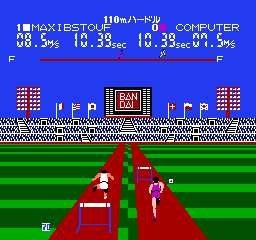
Family Trainer – Running Stadium (Japan)
0 4 4
Family Trainer – Running Stadium (Japan) is a classic NES game that blends physical activity with competitive gameplay, all while capturing the essence of early motion-based titles. Unlike typical video games, this title encourages players to participate actively, simulating running and athletic movements through a combination of timing and coordination. Its inclusion of motion-inspired mechanics distinguishes it from other NES titles, offering a unique experience rooted in physical engagement during a time when gaming primarily meant button presses.
Family Trainer – Running Stadium: Gameplay Overview
The game centers around a virtual athletic competition where players simulate running by performing specific motions or timed button presses. The core gameplay involves matching on-screen prompts that correspond to running steps or other athletic movements, requiring quick reflexes and rhythm. Players must maintain proper timing to succeed, making it a game that rewards coordination and timing accuracy. The gameplay is structured around completing a series of running challenges, with the game tracking performance based on timing and movement precision.
This NES classic emphasizes a straightforward yet engaging mechanic: players perform actions that mimic running or other athletic activities, with the game translating these inputs into in-game progress. The game promotes an active participation style, although it relies on button presses rather than actual physical motion sensors. Its design encourages players to stay attentive to on-screen cues, making it suitable for quick sessions or longer play to improve performance over time.
Modes, Levels and Progression
Within the game, players can engage in multiple running challenges that vary in difficulty and length, providing a range of content for different skill levels. The game does not feature complex storylines or extensive levels; instead, it offers a series of timed or distance-based challenges that require consistent performance. Progression is marked by the player’s ability to complete successive challenges with increasing precision or speed, encouraging repeated attempts to improve scores.
The variety of challenges primarily revolves around different running scenarios, each with unique timing patterns and difficulty scales. Although the game does not include elaborate modes, the variety of challenges maintains replay value, motivating players to refine their timing and coordination. This setup makes it suitable for casual play sessions or competitive attempts to beat personal bests, emphasizing skill development and consistency.
Winning Strategies
Focusing on rhythm and consistency can significantly improve performance in this game. Practice the timing of prompts to develop a sense of rhythm that matches the game’s cues. Maintain concentration throughout each challenge to avoid mistimed inputs. Pay attention to the visual and auditory signals, which are crucial for syncing your actions correctly.
- Start slow to understand the timing pattern before increasing speed for better accuracy.
- Use short, deliberate inputs rather than rushing, which helps maintain control.
- Stay relaxed and avoid tension, as fatigue can impair your timing accuracy.
- Observe patterns in repeated challenges to anticipate upcoming prompts more effectively.
- Consistent practice helps internalize the timing, leading to higher scores and better endurance.
Common Questions About Family Trainer – Running Stadium
How does the difficulty scale across different challenges?
The difficulty increases gradually through faster prompts and more complex timing patterns, requiring better coordination and reaction speed as you progress.
Are there different game modes or only the core running challenges?
The game mainly offers a series of running challenges with varying difficulty levels; it does not feature extensive modes or branching paths but maintains variety through challenge design.
What is the replay value of this game?
Repeated attempts to improve timing and scores provide ongoing motivation, especially as players seek to beat their personal bests or master more difficult challenges. Its straightforward design encourages short bursts of gameplay or longer sessions focused on skill refinement.
Family Trainer – Running Stadium offers a straightforward, engaging experience rooted in timing and coordination. This NES classic emphasizes active participation, making it a distinctive title in its genre. The game’s simplicity and focus on skill development give it a notable replay value for those interested in improving their performance and mastering its challenges.
Related games: you can also try Duck Tales 2 (Japan) and Cocoron (Japan), or browse all other games in the NES category.
How to Play Family Trainer – Running Stadium (Japan)?
Match on-screen prompts by timing button presses to simulate running and athletic movements, completing challenges to improve your score and progress through increasing difficulty levels.
Game Controls
Arrow keys act as the D-pad; Enter is Start; other keys handle action buttons.
You may be interested in:
-
![Zombie Hunter (Japan) [En by KingMike v1.01]](https://www.playf2p.com/wp-content/uploads/zombie-hunter-japan-en-by-kingmike-v1-01-200x120.png) NES
♥ 2
Zombie Hunter (Japan) [En by KingMike v1.01]
NES
♥ 2
Zombie Hunter (Japan) [En by KingMike v1.01] -
 NES
♥ 1
Zombie Hunter (Japan)
NES
♥ 1
Zombie Hunter (Japan) -
 NES
♥ 1
Zoids Mokushiroku (Japan)
NES
♥ 1
Zoids Mokushiroku (Japan) -
 NES
♥ 2
Zoids 2 – Zenebas no Gyakushuu (Japan)
NES
♥ 2
Zoids 2 – Zenebas no Gyakushuu (Japan) -
 NES
♥ 1
Zoids – Chuuou Tairiku no Tatakai (Japan)
NES
♥ 1
Zoids – Chuuou Tairiku no Tatakai (Japan) -
 NES
♥ 11
Zippy Race (Japan)
NES
♥ 11
Zippy Race (Japan) -
 NES
♥ 1
Zhen Ben Xi You Ji (Asia) (Unl)
NES
♥ 1
Zhen Ben Xi You Ji (Asia) (Unl) -
 NES
♥ 1
Zenbei!! Pro Basket (Japan)
NES
♥ 1
Zenbei!! Pro Basket (Japan)
Comments (0)
No comments yet. Be the first to comment!